





Warehouse leaks seldom start with a dramatic failure. More often, a single loose screw, a crushed washer, or a joint that keeps collecting water gives the first clue. In a prefab steel warehouse, moisture can move from the outer sheet into insulation, purlins, stored goods, and maintenance work. A deliberate fastener check helps an owner decide whether the problem is a local repair or evidence of a larger roof detail issue.
Fasteners are small parts with a large weathering role
A fastener holds more than a sheet in place. Its location, washer condition, grip on the support, and fit with the sheet profile all affect how the roof handles rain and wind. Color-coated steel sheet works as part of an assembly. A screw that is loose, leaning, corroded, or driven too far can therefore put a much wider area at risk.
The washer is the first clue
A sound washer should sit flat against the panel and keep its shape. Splitting, hardening, sideways movement, or a missing washer removes that seal at the penetration. Simply tightening an over-driven screw is not a reliable fix: the extra pressure may distort the sheet or damage the sealing material that is still in place.
Water patterns reveal more than a single screw
Staining beneath a fastener line, rust around a screw head, damp insulation, or repeated drips at a lap should be treated as a pattern. The cause may be drainage, panel movement, an unsupported edge, or an ill-matched repair rather than the visible screw alone. Follow the water route first; the right repair depends on where that route begins.
A focused inspection distinguishes local faults from system faults
The goal is not to make every screw look new. It is to find out whether a recurring defect is isolated or linked to a roof detail that will keep loading the same spot. A short, targeted review gives an owner a workable scope before a small repair turns into repeated patching:
- Start at eaves, ridges, laps, penetrations, gutters, and roof-access routes. These details see more movement and water than broad field areas.
- Use nearby sound screws as a comparison. Differences in washer shape, screw angle, or panel deformation are easier to see side by side.
- Follow staining and debris uphill. That path can show whether drainage or a lap is feeding the fastener location.
- Map defects by roof zone. Several problems on one line usually justify checking the detail, not just replacing each screw in turn.
| Visible condition | What to confirm | Repair decision it supports |
| One loose or missing fastener | Panel hole, washer, thread engagement, and nearby support | A compatible local replacement when the sheet and support remain sound |
| Several defects on one line | Panel movement, support alignment, lap condition, and drainage | Review the detail before replacing screws one by one |
| Rust or staining around penetrations | Coating damage, retained moisture, sealant condition, and water route | Treat the water source and affected metal together |
| Dampness below a panel joint | Lap direction, flashing, gutter flow, and insulation condition | Investigate the assembly instead of sealing the nearest screw only |
Roof type and repair history change the right response
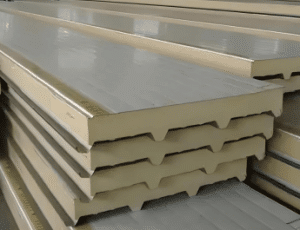
A prefabricated warehouse building may use exposed-fastener sheets, concealed-fastener panels, or insulated assemblies. The weathering line sits in a different place in each system, so a repair copied from another roof can be wrong. With a metal sandwich panel roof, the panel joint, insulation continuity, and support condition need to be considered together when water appears near a fastening point.
Repair history is part of the diagnosis. Several sealant patches on a prefabricated steel warehouse may have hidden the symptom while the original movement or drainage problem continued. Use materials and methods that remain compatible with the coating, fastener, and lap on color-coated steel sheet. The aim is a durable weathering detail, not the quickest visible cover.
A repair should preserve the whole roof detail
A steel warehouse construction project benefits from treating the roof as one connected envelope. Fastener, panel profile, flashing, closure, support spacing, and drainage route all have to work together. When a screw is replaced, confirm that the new fastener suits the existing sheet and that the panel still bears firmly on correctly located support.
Replacement is not always the smallest sensible scope
One replacement can be the right scope when the defect is genuinely local. A line of loose fasteners, elongated holes, repeated sealant failures, or corrosion spreading below the surface needs a wider look. That review can show whether the problem stays within one roof zone, calls for panel replacement, or requires drainage and support corrections before new materials go in.
For warehouses still in planning, the same lesson belongs upstream. KERUI Metal can coordinate steel structure design, fabrication, construction, and connection components around the building geometry, giving roof and wall systems a clear supporting framework. Early coordination cannot remove future maintenance, but it reduces the chance that a routine fastener check begins with an unresolved detail.
The practical takeaway
Fastener checks matter because they turn an unexplained drip into a decision about the roof detail around it. Look at the washer, panel surface, support, water path, and earlier repairs before choosing a remedy. One isolated fault may respond to a compatible repair. A repeating pattern means the steel building roof needs the detail that keeps creating the fault corrected.
FAQ
How often should a prefab steel warehouse roof be checked?
Inspect after severe weather, before the wet season, and whenever new staining or a recurring drip appears. The interval should also match the roof profile, local exposure, roof traffic, and the condition recorded at the previous inspection.
Can a loose screw simply be tightened?
Only if the washer, panel hole, and supporting member are sound and the fastener can seat correctly. An enlarged hole, damaged washer, or poor thread engagement means tightening alone may not restore the weathering detail.
What makes fastener corrosion a bigger concern?
Corrosion deserves more attention when it moves from the screw head into the panel, appears in repeated locations, or comes with standing water and damaged coating. Those signs put the water path and surface condition on the same inspection list as the fastener.
Do roof leaks always begin at fasteners?
No. Water can enter at a lap, flashing, penetration, gutter, or damaged panel and emerge near a fastener line. Trace the route instead of assuming that the visible drip marks the entry point.
When should a repair become a broader roof review?
Broaden the review when defects repeat along one line, repairs fail again, panel holes are distorted, corrosion is spreading, or dampness reaches insulation or interior areas. In those cases, replacing one fastener may only hide the symptom.